

Data Augmentation for EEG-BCI Pipelines: Training Bayesian Decoders with Limited Labeled Data
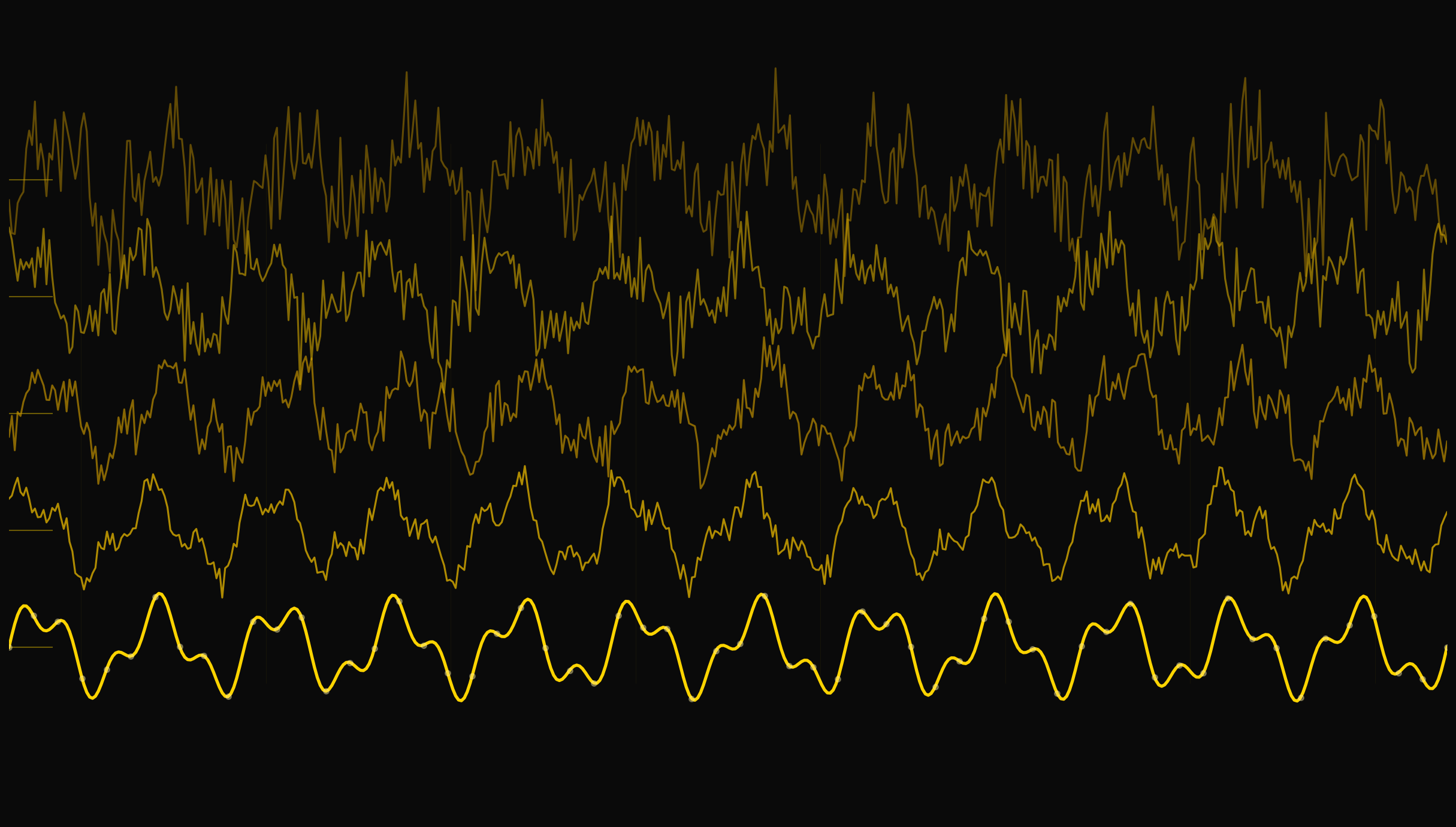
Every BCI calibration session ends with the same uncomfortable arithmetic. You've collected 80 motor-imagery trials, maybe 120 if the subject was patient. Your Bayesian classifier needs enough data to estimate reliable posteriors — but the calibration window that users will tolerate is measured in minutes, not hours. The result is a chronic mismatch between what probabilistic models want and what BCI paradigms deliver (see BCI Calibration with Nimbus Studio: From Hardware to Trained Decoder).
Data augmentation is the most practical answer to this mismatch. By generating plausible synthetic variants of recorded trials, augmentation expands your effective training set without adding a single second of subject time. Done correctly, it doesn't introduce spurious patterns — it regularizes the feature space so that downstream Bayesian decoders generalize better to new sessions and unseen noise conditions.
This post explains the core augmentation strategies available in Nimbus Studio's Data Augmentation node, why each one makes sense from a probabilistic perspective, and how to configure them for real BCI pipelines.
Why Limited Labeled Data Breaks Bayesian Classifiers
Bayesian classifiers — NimbusLDA, NimbusQDA, NimbusSoftmax — estimate parameters from labeled examples. With enough data, those estimates are precise: the posterior over model parameters collapses toward the truth, and predictions are sharp and well-calibrated. With 60 trials per class, the story is different.
For NimbusLDA, the shared covariance matrix is estimated from all training samples. With few trials and many EEG channels, the matrix becomes rank-deficient or poorly conditioned. Even with shrinkage regularization, the classifier is essentially interpolating between noisy estimates of class means — and the posteriors it produces reflect that uncertainty. Predictions are correct on average but brittle: a slight change in electrode impedance or alertness level between training and deployment can drop accuracy by 15–20 percentage points.
The deeper issue is coverage. A small training set samples only a narrow corridor of the true data distribution. Augmentation widens that corridor, so the classifier has seen more of the realistic variation it will encounter at deployment time.
The Three Core Augmentation Strategies
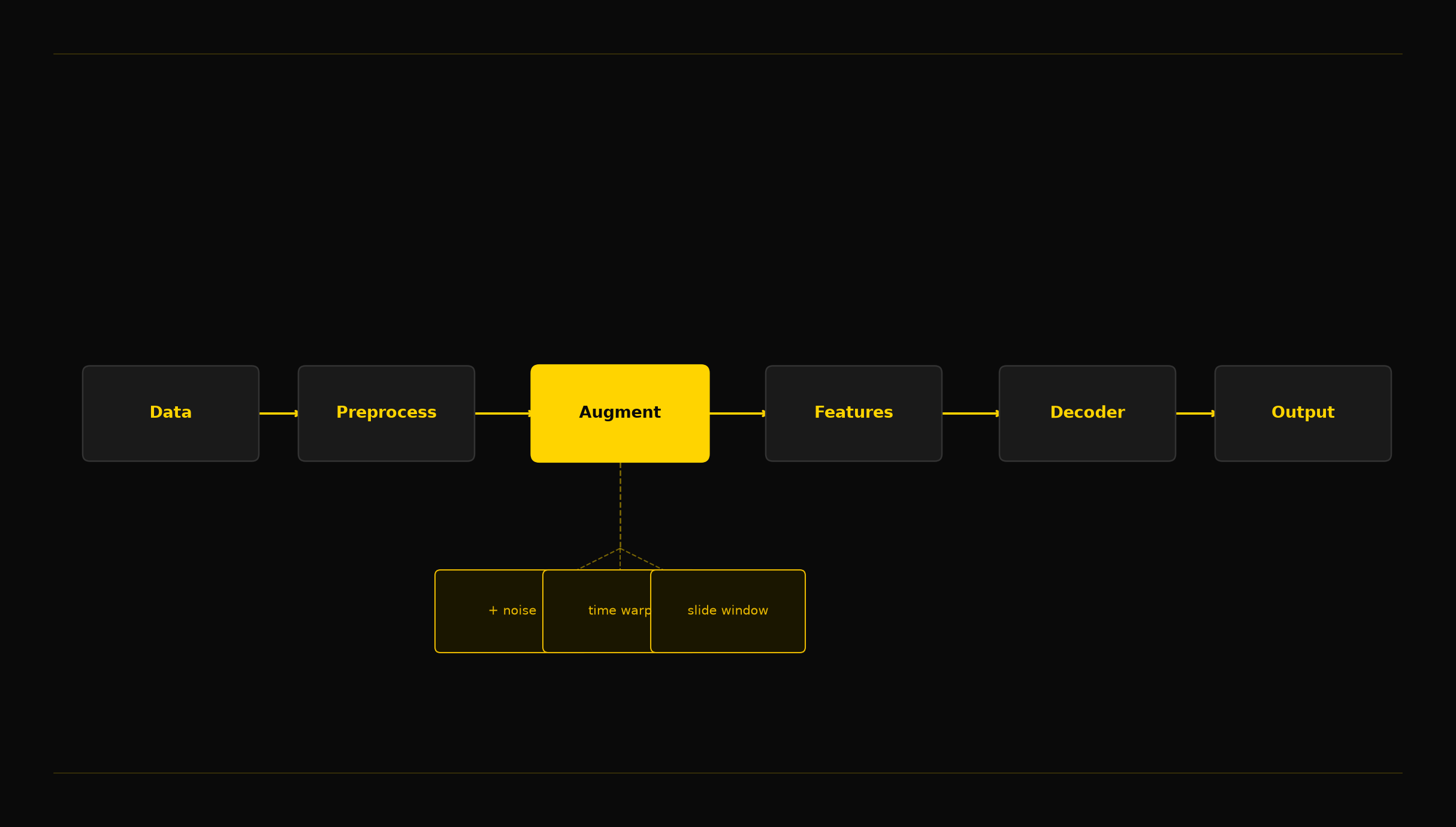
Nimbus Studio's Data Augmentation node supports three strategies that complement each other cleanly and apply in different layers of the pipeline.
Sliding Window Sampling
Sliding windows are the highest-leverage augmentation for epoched BCI data. Instead of extracting a single fixed epoch per stimulus event, you extract multiple overlapping windows across the trial duration. A 1-second motor-imagery trial at 250 Hz sampled with a 0.75-second window and 50 ms stride yields roughly 6 epochs from a single trial — a 6× expansion of training samples with no additional subject time (related: Epoch Design and Trial Structure in BCI).
This strategy works because EEG motor-imagery ERD/ERS patterns are distributed across the trial window rather than locked to a precise onset. The classifier learns to recognize the pattern regardless of where in the window it appears, which improves robustness to trial-onset jitter and inter-session timing variation. The key constraint: windows must still respect your epoch tmin/tmax convention so downstream CSP filters and Bayesian models see data in the correct temporal reference frame.
Gaussian Noise Injection
Noise injection adds a small amount of Gaussian noise to each training trial. The noise is calibrated to be sub-perceptual — typically 5–15% of the trial's RMS amplitude — but non-trivial from the classifier's perspective.
From a Bayesian standpoint, this is equivalent to placing a smoothed prior over the feature distribution: the model sees not a single point in feature space per trial but a distribution around that point. The result is that class-conditional Gaussians estimated by NimbusLDA and NimbusQDA have broader, better-regularized covariances. The classifier becomes less sensitive to exactly reproducing the training noise floor and more sensitive to the spatial and spectral structure that actually separates classes.
Noise injection pairs especially well with CSP features. CSP log-variance features are already relatively robust to additive Gaussian noise in the raw signal, so moderate injection levels increase training diversity without distorting the feature geometry.
Time Warping
Time warping applies smooth, randomly sampled temporal distortions to each trial — slightly stretching some segments and compressing others. The overall trial length is preserved, but local timing relationships are perturbed.
This is particularly valuable for paradigms where inter-trial variability in neural dynamics is a known confound. Motor-imagery ERD onset, for example, varies by 100–300 ms across trials and subjects. A classifier trained only on un-warped trials implicitly assumes tighter timing than the brain actually produces. Time-warped training examples teach the model to be less sensitive to this variability.
Time warping should be used conservatively — overly aggressive warping can erase the temporal structure that makes ERP features like P300 peaks discriminative. For P300 pipelines using xDAWN features, favor noise injection and sliding windows over heavy time warping.
Configuring the Data Augmentation Node in Nimbus Studio
The Data Augmentation node sits between your preprocessing stack and your feature extraction nodes. A typical motor-imagery pipeline looks like this:
custom_data → highpass_filter → bandpass_filter → epoching → baseline_correction → data_augmentation → csp → rxlda_sdk → cross_validation → results_output
A few configuration principles worth emphasizing:
Augmentation is training-only. The Data Augmentation node is explicitly batch-only in Nimbus Studio — it has no streaming deploy path. This is by design. You augment the training set to improve generalization; at inference time, you pass real recorded data through the same preprocessing stack and into the fitted decoder. Never apply augmentation to evaluation data or held-out test sets — this inflates accuracy estimates and breaks the honest generalization contract that cross_validation enforces.
Pair with cross-validation carefully. When you use sliding windows, individual epochs from the same trial are correlated. A naive k-fold split can leak overlapping epochs between train and validation folds. Use trial-level grouping in cross-validation to ensure that all windows derived from the same original trial end up in the same fold.
Watch class balance. Augment each class proportionally. If you augment the minority class more aggressively to correct imbalance, ensure the augmentation level is documented — downstream accuracy numbers will reflect the augmented distribution, not the natural one.
How Augmented Data Interacts with Bayesian Priors
One of the underappreciated benefits of augmentation in probabilistic pipelines is the interaction with the classifier's prior. Bayesian models like NimbusLDA and NimbusSoftmax combine the prior over parameters with the likelihood of the training data. With very few real trials, the prior dominates — which is appropriate, but means the model is effectively leaning heavily on assumptions built into the SDK (and makes uncertainty quantification especially important when you deploy).
Augmented training data increases the effective sample size seen by the likelihood term, nudging the posterior toward the data rather than the prior. The result is not a fully data-driven model — the prior still provides useful regularization — but a better-calibrated balance between prior knowledge and observed EEG structure. In practice, this shows up as narrower posterior credible intervals on class probabilities and more stable accuracy across cross-validation folds.
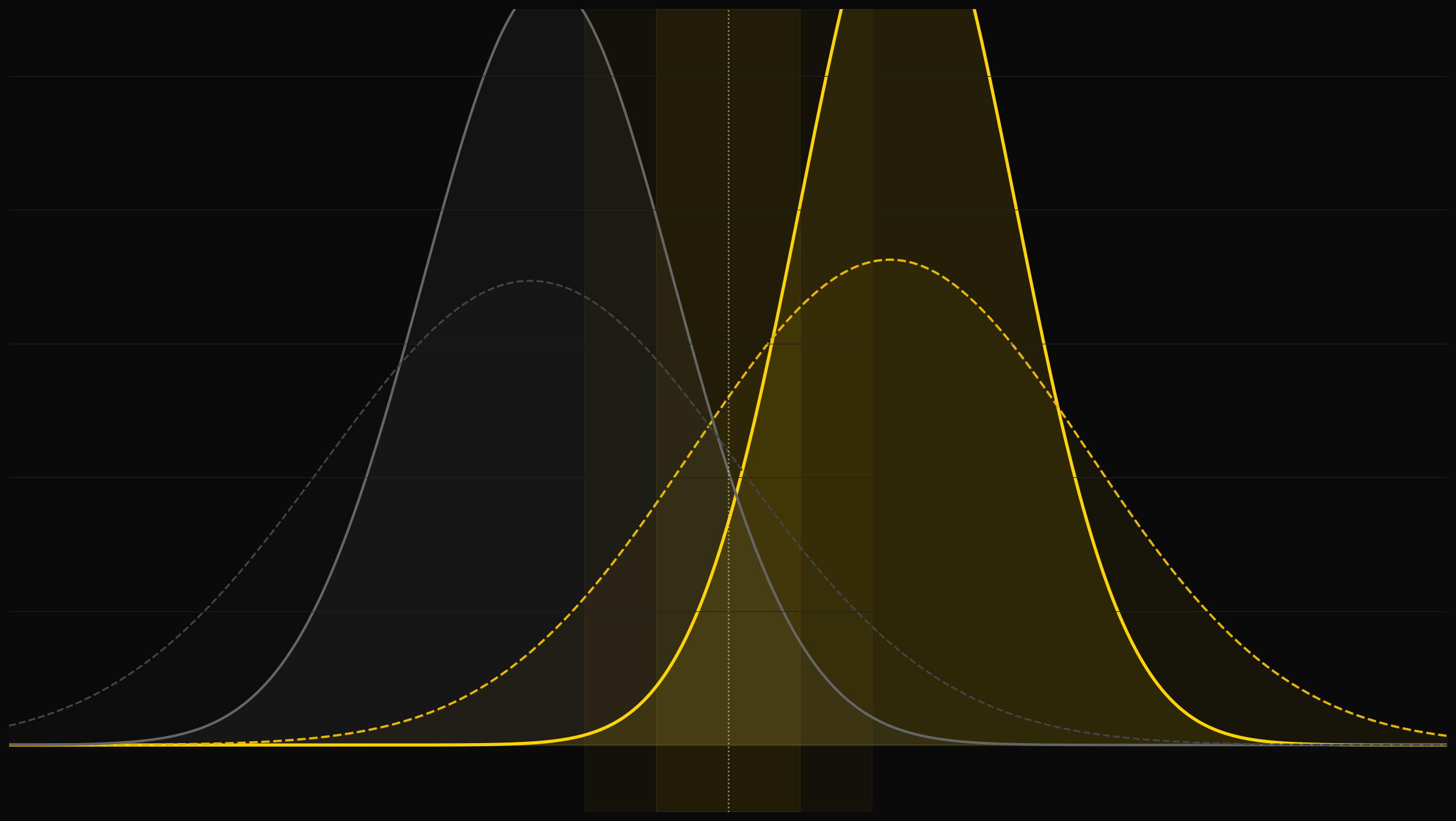
The figure above illustrates the effect intuitively. The solid curves represent class-conditional distributions estimated from a small unaugmented training set — peaked but potentially misplaced. The dashed curves show the distributions after augmentation: broader, more conservative, and better covering the realistic spread of EEG features. The classifier's decision boundary becomes more robust precisely because it has learned from a wider sample of plausible signal variation.
Practical Recommendations for BCI Engineers
Start with sliding windows. The accuracy gain per configuration effort is the highest of the three strategies, and the implementation is straightforward in Nimbus Studio. Even a modest 50% window overlap doubles your training set size.
Add noise injection as a second layer of regularization, especially if you are using NimbusQDA or NimbusSoftmax with high-dimensional feature vectors. Keep the noise amplitude below 10% of RMS unless you have evidence that your recording environment is particularly noisy.
Reserve time warping for paradigms where you know temporal variability is a problem — ERP spellers, for example, benefit less than motor-imagery pipelines where response timing drifts across a session (more on long-session drift handling: Continual Learning in BCI).
Always validate augmented pipelines against a held-out real-data test fold before claiming generalization. The cross-validation node in Nimbus Studio makes this straightforward; use it every time you introduce a new augmentation configuration.
Conclusion
Data augmentation is not a shortcut around good experimental design — it is a principled tool for making the most of the calibration data you have. Sliding windows, noise injection, and time warping each address a different aspect of the limited-data problem, and they compose cleanly in a Nimbus Studio pipeline. When paired with Bayesian classifiers that naturally quantify uncertainty (guide: Choosing the Right Bayesian Classifier for Your BCI Pipeline), augmented training sets produce decoders that are not just more accurate on held-out data but more honest about what they do and do not know.
The next time your calibration session ends with 80 trials and a skeptical subject, reach for the Data Augmentation node before reaching for more recording time. Your Bayesian decoder will thank you.