

Zero-Calibration BCI with Nimbus Studio's Indicator Nodes: When You Don't Need a Trained Decoder
Most BCI tutorials assume a trained decoder. You collect calibration trials, fit a classifier, validate on held-out data, and only then deploy. That pipeline is the right choice when you need personalised, high-accuracy decoding — but it is not the only choice. A growing class of BCI applications works without any per-user training at all, and Nimbus Studio has first-class support for building them.
This post explains how Nimbus Studio's indicator nodes — bandpower_indicator and blink_detector — enable real-time brain-state monitoring and interactive applications with zero calibration overhead. It covers the INDICATOR and EVENT data types that underpin them, shows how to wire a complete no-calibration pipeline, and gives you a principled framework for deciding when indicators are the right tool versus when you genuinely need a trained decoder. (If you do need a trained path, start with BCI Calibration with Nimbus Studio: From Hardware to Trained Decoder.)
What Is a Zero-Calibration BCI?
A zero-calibration BCI does not require labelled data or a trained model. Instead of learning a decision boundary between mental states, it computes an interpretable signal — typically a spectral feature or an event marker — directly from raw EEG and thresholds it. The resulting output is deterministic given the signal and the threshold: no training run, no cross-validation, no deployment checkpoint.
This is not a compromise version of BCI. For a wide class of use cases — neurofeedback, focus monitoring, blink-based switching, mental workload gauges — indicators are the architecturally correct choice. They are low-latency, immediately deployable, and produce signals that are interpretable without a probabilistic model. The tradeoff is that they are less discriminative: a bandpower_indicator over alpha is sensitive to more than just relaxation, and it cannot separate motor-imagery classes. Precision requires calibration; immediacy does not.
If you're thinking about reliability under real-world non-stationarity, it's also worth understanding how neural drift breaks static decoders — and how online Bayesian updates handle it.
The INDICATOR and EVENT Data Types
Nimbus Studio's ADR-002 extension introduced two new first-class data types that make zero-calibration pipelines a coherent architecture rather than a workaround.
INDICATOR is a continuous scalar stream. Each frame carries a numeric value — power in a frequency band, a normalised relaxation score — alongside a timestamp. Downstream nodes and connected applications receive this as a real-time signal they can threshold, smooth, or map to a control dimension. The value is meaningful without a classifier: it reflects the magnitude of a neural feature, not a class posterior.
EVENT is a discrete marker stream. When a threshold crossing or a detected artefact occurs, an EVENT is emitted with a type label and timestamp. Applications consuming the stream get a sparse, timestamped sequence of occurrences rather than a continuous signal — the right shape for blink-to-click interactions or cognitive load alerts.
Both types flow through Nimbus Studio's standard node graph and can be routed to OSC or LSL output for consumption by external applications, making them first-class citizens of the live deploy path.
Nimbus Studio's Indicator Nodes
Two nodes implement zero-calibration sensing in the current Studio release:
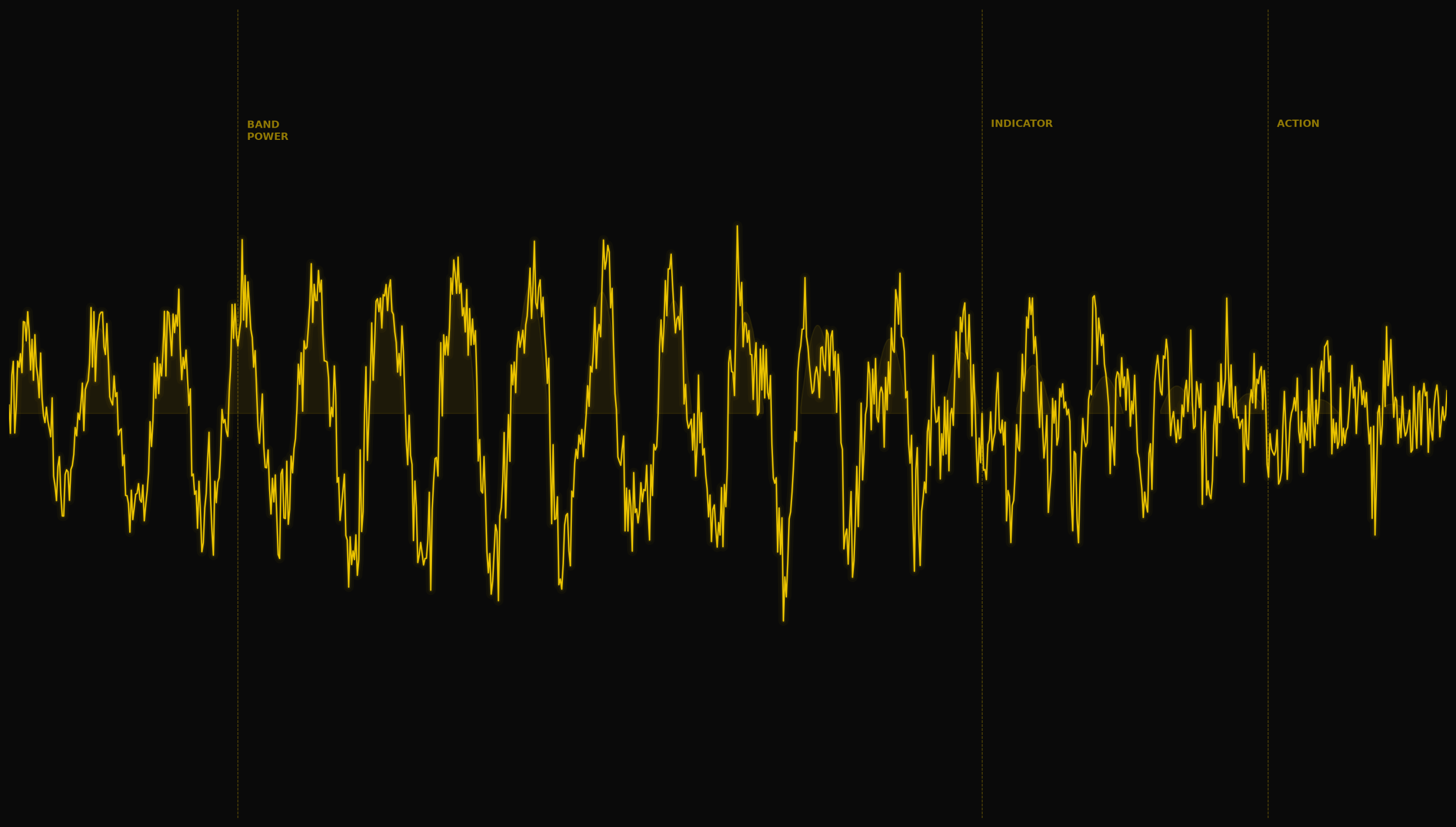
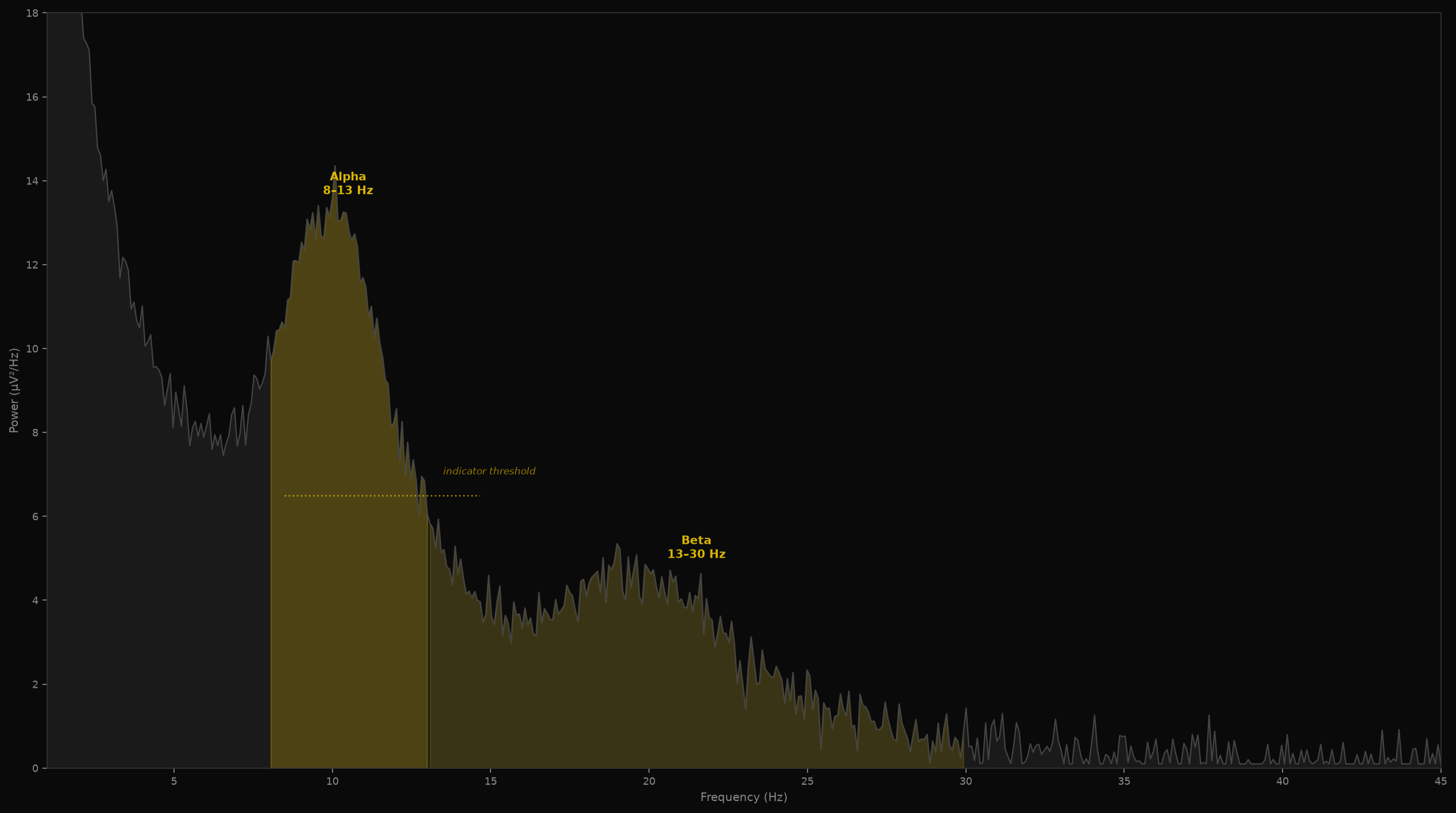
bandpower_indicator computes spectral power in a configurable frequency band — typically alpha (8–13 Hz) or beta (13–30 Hz) — on a rolling window of incoming EEG. The output is a continuous INDICATOR stream. Common applications include relaxation gauges (elevated alpha), focus monitors (beta suppression or frontal theta), and workload indices. The node requires no training: you configure the band, the window length, and an optional normalisation baseline, and it is immediately ready to deploy alongside a hardware_device node.
In practice, the quality of what you stream here is dominated by preprocessing. If you're seeing unstable indicators, start with the basics: Cleaning EEG Before It Reaches Your Decoder: ICA, Artifact Rejection, and EOG Removal in Nimbus Studio.
blink_detector monitors the EOG signature of eye blinks in the raw EEG or a dedicated EOG channel. When a blink is detected, it emits an EVENT. In clean signals it can be very reliable; configurable debounce and no per-user threshold fitting make it a good choice for blink-based switching interfaces. It is used in Nimbus Studio's zero-calibration Interactive Games — the Focus and Blink-to-Click apps ship with blink_detector as their sole sensing layer.
Wiring a Zero-Calibration Pipeline in Nimbus Studio
A zero-calibration pipeline is simpler to configure than its trained counterpart. The canonical path is:
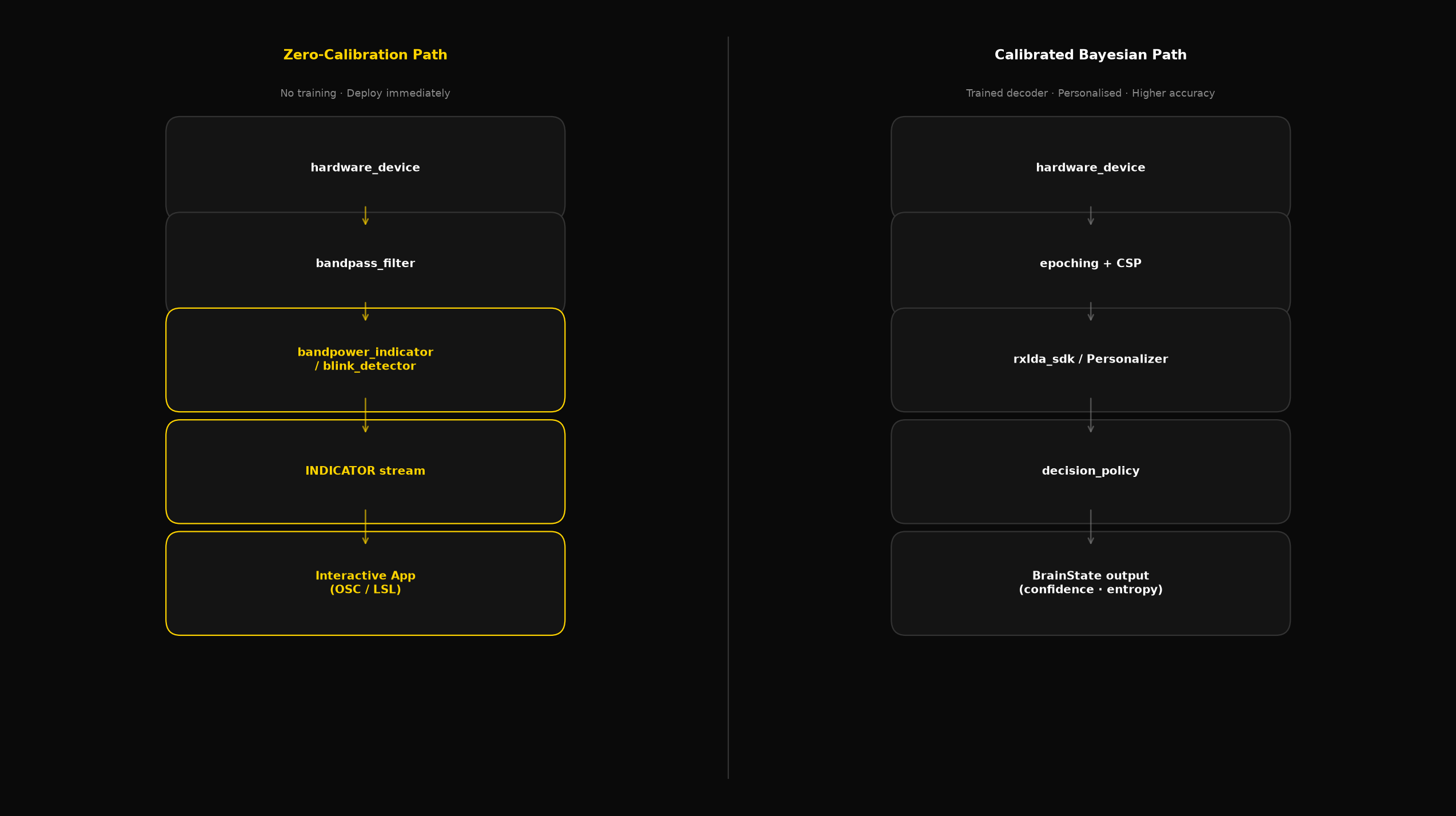
hardware_device
    → highpass / bandpass_filter   (frequency hygiene)
    → bandpower_indicator           (or blink_detector)
    → interactive_application       (OSC / LSL output)
Start with a hardware_device node targeting your EEG headset — BrainFlow and LSL sources are both supported. Add a highpass filter at 1 Hz to remove DC drift, then a bandpass_filter scoped to your target band (e.g. 7–14 Hz for alpha). Feed the filtered signal into bandpower_indicator. Configure the band boundaries, the rolling window size (250–500 ms is typical for neurofeedback), and whether to apply z-score normalisation against a resting baseline collected at the start of the session.
The node's INDICATOR output connects directly to an interactive_application node or to Nimbus Studio's OSC/LSL output handler. In the Interactive Games layer, Focus and Relaxation apps consume this stream natively. For custom applications, the OSC endpoint makes it straightforward to drive any OSC-compatible software — game engines, Max/MSP patches, or custom Python listeners — from the indicator signal.
For a blink interface, replace bandpower_indicator with blink_detector. Configure the detection threshold and the debounce interval (typically 300–500 ms to avoid double-counting). The EVENT output maps directly to the Blink-to-Click preset in Nimbus Studio's Interactive Games, or forwards over OSC/LSL to any external application.
When to Use Indicators vs. a Trained Decoder
The decision comes down to what you are trying to distinguish and whether you have the calibration budget to distinguish it.
Use indicator nodes when:
- You need to deploy immediately, before any calibration data is available.
- The application maps to a single continuous dimension (relaxation level, workload, blink events) rather than discrete class labels.
- The user population is too heterogeneous for a shared model, and per-user training is operationally infeasible.
- The signal you want — alpha power, blink — is sufficiently stereotyped across users that a fixed computation gives acceptable performance.
Use a trained Bayesian decoder (rxlda_sdk, Personalizer, or NimbusSoftmax) when:
- You need to separate discrete mental-imagery classes (left hand vs. right hand, P300 target vs. non-target).
- Accuracy above chance on individual users matters — indicators are noisy across users and sessions.
- You can afford the calibration session and the training time.
- Online adaptation (
partial_fitvia the Personalizer node) will further improve performance across sessions.
The two paths are not mutually exclusive. A common architecture uses a bandpower_indicator to gate a calibrated decoder: if alpha power is below a quality threshold, the indicator signals a "not ready" state and the decoder is not queried. This is particularly effective in consumer-grade or wearable deployments where signal quality is variable.
Conclusion
Zero-calibration BCI is not a fallback — it is a distinct design point with genuine advantages for a significant class of applications. Nimbus Studio's bandpower_indicator and blink_detector nodes, backed by the INDICATOR and EVENT data types introduced in ADR-002, make it straightforward to build live brain-state applications that deploy immediately and compose cleanly with the rest of the Studio pipeline graph.
For engineers building neurofeedback tools, focus trackers, blink interfaces, or interactive experiences where session-zero usability matters, indicator nodes are the right starting point. And when your use case eventually demands a trained decoder, the same hardware_device and filter graph are already in place — you add epoching, a model node, and a decision_policy without rebuilding from scratch.
If you want to see what that trained-to-live jump looks like end-to-end, From Training to Streaming: Deploying a Live EEG Decoder with the Nimbus Python SDK walks through the deploy loop, confidence gating, and online adaptation.