

Conductor: Adaptive BCI Without Constant Recalibration
🧠 Brain-computer interfaces often work beautifully in demos, then degrade in the real world. EEG signals drift as electrodes shift, users fatigue, posture changes, and signal quality fluctuates. Traditional systems respond by repeatedly asking users to recalibrate — which breaks focus and makes BCI feel exhausting.
Conductor is the Nimbus SDK’s real-time adaptation and safety layer for EEG-BCI. It continuously diagnoses whether uncertainty comes from distribution drift, model ignorance, or transient signal noise — governing online updates, label requests, and rollback safety without stalling the streaming loop.In final multi-dataset certifications (20,214 runs across 89 subjects), Conductor achieved full-calibration accuracy in as few as 4 trials via population priors, cut label requests by up to 44%, delivered a +20% increase in Information Transfer Rate (ITR), and maintained a 17.5ms mean adaptation step.
Availability note: Conductor, population priors, and the APIs shown here ship with
nimbus-bci0.6.0 — merged tomainwith the dated changelog entry on 2026-09-10; PyPI publish pending (latest on PyPI: 0.5.0). The classical heads, the Personalizer middleware, andBrainStateoutputs are available today in 0.5.0. Code and tables in this post were updated on 2026-09-10 to match the public 0.6.0 API surface documented in the repo README and CHANGELOG.
The Real-World Dilemma: Why Neural Decoders Fail
In a lab demo, a BCI can look effortless. In everyday consumer and clinical use, non-invasive BCIs face three stubborn practical hurdles:
- Brain signals drift continuously. Sweating, subtle electrode shifts, fatigue, and posture changes alter EEG distributions within minutes.
- Calibration fatigue is real. Constantly interrupting the user to ask, “What action were you trying to perform?” breaks immersion and causes severe task fatigue.
- Online retraining is slow, risky, and compute-heavy. Updating deep neural networks on the fly can introduce multi-second latency spikes, drain battery, and trigger catastrophic failure if corrupted or noisy feedback is treated as ground truth.
In other words: the decoder must keep learning, but it cannot constantly interrupt the user or risk damaging its own performance.
| Comparison Dimension | Traditional Online BCI | Nimbus SDK with Conductor |
|---|---|---|
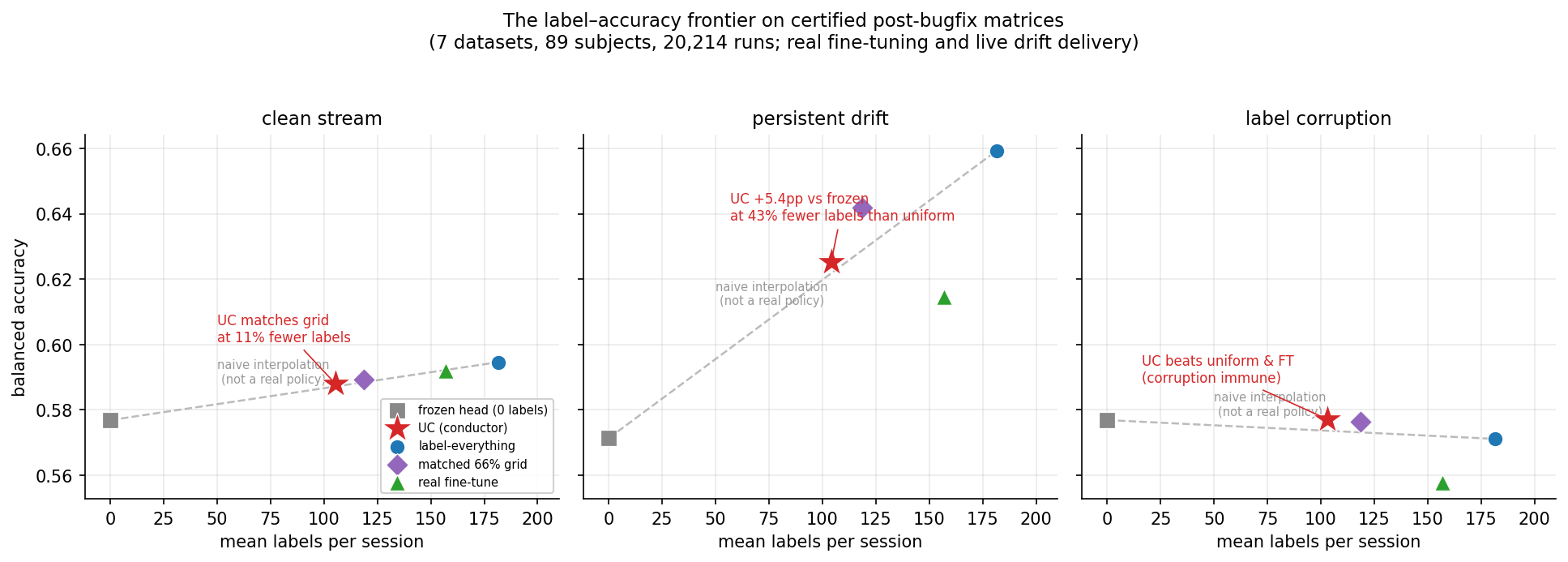
| Drift Handling | Often degrades over time or requires explicit recalibration stops | +1.1pp clean / +3.9pp to +5.0pp under sustained drift, without explicit recalibration stops (p ≤ 0.002, Holm-corrected) |
| User Prompting | Frequent, interruptive calibration prompts throughout the session | 44% fewer label requests vs. matched fixed grids (96 vs. 170 per run); the user is prompted only when Conductor asks |
| Model Safety | Online updates risk catastrophic forgetting and adversarial corruption | ShadowGuard parallel monitoring + CUSUM regret rollback (0/36 negative regressions) |
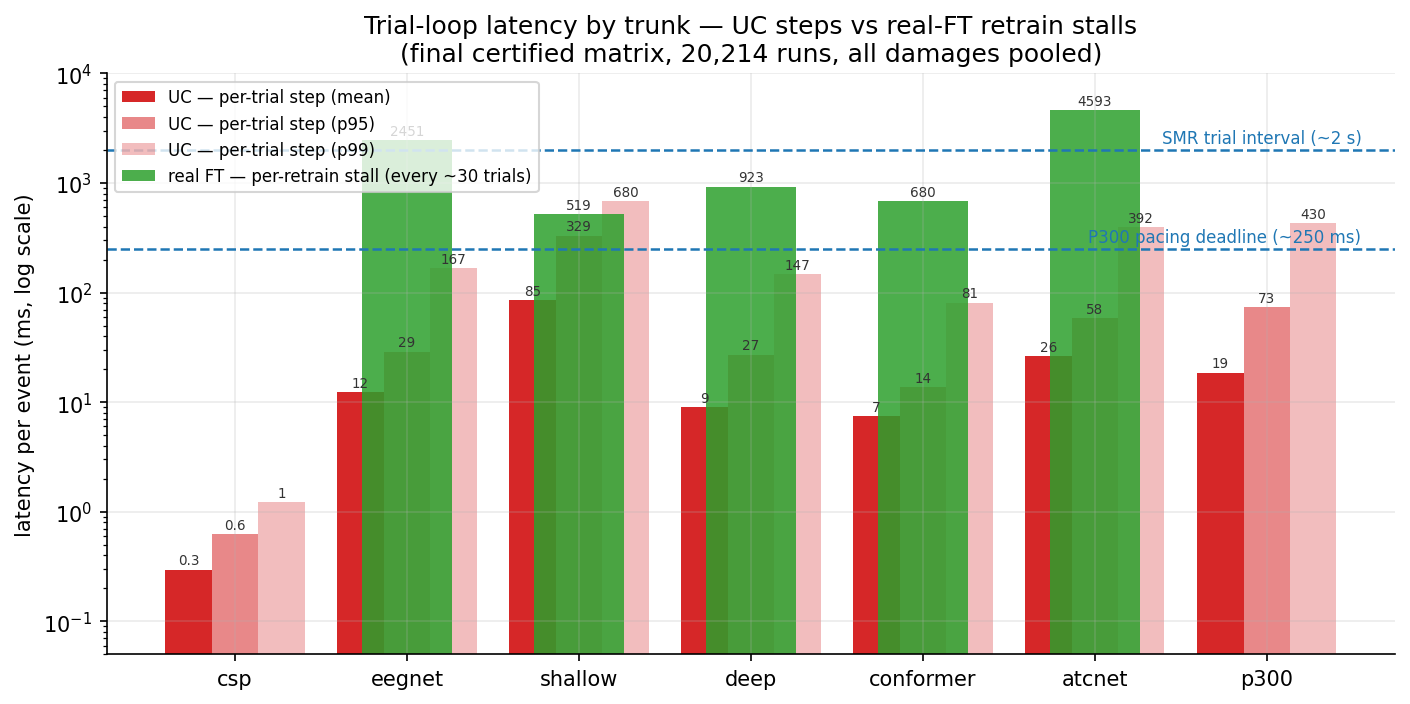
| Latency & Compute | Large-model retraining stalls the real-time loop (100–600ms per event) | 0.18–1.88ms per head flush; 17.5ms mean / 52ms p95 orchestrator step — no retraining stalls |
1. The Core Idea: Diagnose Before You Adapt
Conductor does not simply ask, “Is the model confident?”
It asks a more fundamental question: why is the model uncertain, and what is the safest corrective action?
At each trial, Conductor evaluates the joint diagnostic state:
State_t = (
  Drift_Score θ_D,
  Epistemic_Uncertainty θ_E,
  Aleatoric_Uncertainty θ_H
)
Rather than using diagnosis purely to trigger reactive label requests (which our 89-subject benchmark proved is sub-optimal under continuous drift), Conductor operates under a grid-first acquisition doctrine (base_label_rate=0.5 with epistemic discounting). Diagnosis then directly governs adaptation mechanism routing, safety budgets, artifact vetoes, and abstention:
- Covariate / Distribution Drift (): Triggers embedding-space alignment (such as unsupervised CORAL) or drift-gated head updates without requiring extra user labels.
- Concept Shift / Informative State (): Prioritizes supervisory labels for genuinely novel brain states where feedback directly improves generalization.
- Transient Noise / Artifacts (): Emits predictions while skipping label acquisition to avoid training on corrupted or low-signal epochs.
┌─────────────────────────────────────────────────────────────┐
│                  CONDUCTOR STREAMING ENGINE                 │
│   • Raw Artifact Veto (Kurtosis > 10.0 excludes blinks/EMG) │
│   • Distribution Drift (Windowed Mahalanobis Shift θ_D)     │
│   • Epistemic Uncertainty (NIW Posterior Dispersion θ_E)    │
│   • Aleatoric Uncertainty / Noise (Entropy Ceiling θ_H)     │
└──────────────────────────────┬──────────────────────────────┘
                               │
            ┌──────────────────┼──────────────────┐
            ▼                  ▼                  ▼
     [ HIGH DRIFT ]     [ HIGH EPISTEMIC ] [ HIGH ALEATORIC ]
   Unsupervised CORAL   Request Informative  Emit Prediction
   / Head Update       Supervisory Label     (Skip Corrupted
   (Latched Episodes)  (Targeted Budget)     Label Requests)
            │                  │                  │
            └──────────────────┴──────────────────┘
                               │
                               ▼
               [ CASCADE LADDER (CascadeLadder) ]
         Head (LDA/QDA) ──► CORAL (Covariance Alignment)
      Guarded by: ShadowGuard (CUSUM Regret + Revert Watchdog)
2. Smart Diagnosis & Noise Protection: Knowing When to Learn
Standard machine learning systems collapse uncertainty into a single scalar confidence score. In neurotechnology, that is dangerous.
There are two very different reasons a BCI decoder might be uncertain:
- Model uncertainty (epistemic): “The decoder has not seen brain patterns in this region of embedding space before.” Asking the user for feedback here provides high-value supervisory signal that immediately improves accuracy.
- Signal noise (aleatoric): “The user blinked, moved a jaw muscle, or an electrode briefly lost contact.” Asking for feedback here is harmful because the resulting label would train the decoder on corrupted features.
Conductor deploys three layers of noise and corruption defense:
- Fast-Path Artifact Veto: Raw trials with extreme kurtosis () from blinks or muscle spikes are excluded from drift statistics so transient artifacts cannot trigger false drift alarms.
- Hardware Fault Fallthrough: Dead or flatlined channels are detected and surfaced as hardware warnings (
hardware_fault=True) while maintaining drift tracking so spatial transforms (CORAL) can adapt to dropped channels. - Label Quarantine Trickle Valve: Delivered labels that contradict both the active head and the frozen baseline across consecutive trials are held in quarantine. An even trickle valve (
quarantine_accept_every=3) prevents label starvation while entry-snapshot rollbacks protect posterior rankings from adversarial flips.
3. Fast Onboarding: Peak Accuracy in 4 Trials
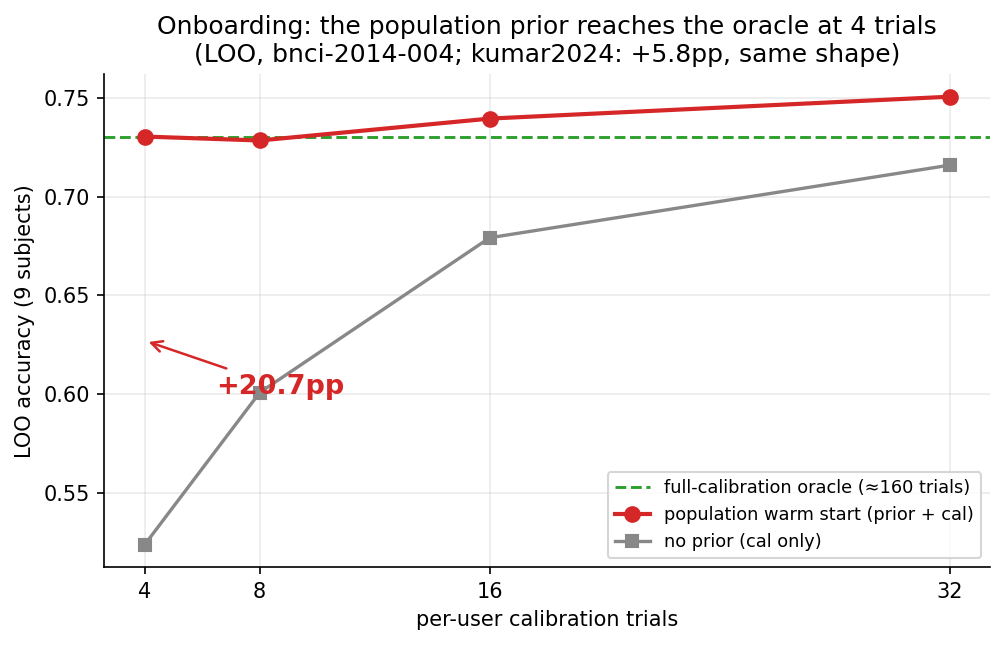
Historically, new BCI users had to endure 40 to 100 repetitive calibration trials before their decoder reached acceptable accuracy.
Conductor eliminates this cold-start burden through population priors over Bayesian heads. Using Normal-Inverse-Wishart (NIW) moment matching of pooled posteriors, the SDK aggregates calibration distributions from prior users into a structured prior (public entry point: Personalizer.fit_population(...)). Crucially, the pooled scale explicitly incorporates between-subject scatter rather than assuming homogeneous users:
To protect against heterogeneous populations where prior transfer might fail, Conductor applies a prior-predictive gate. If a population prior predicts the new user's initial calibration trials below chance, it automatically falls back to diffuse fitting.
On benchmark datasets like BNCI-2014-004, this warm-start approach achieves full-session accuracy within 4 calibration trials, delivering an immediate +20.7 percentage point lift over training from scratch.
4. Real-Time Latency Contract: Sub-Millisecond Adaptation
Interactive BCIs operate under strict timing deadlines. P300 spellers require decisions within ~250ms, while sensorimotor rhythm (SMR) loops demand responsive pacing without latency jitter.
Conductor is engineered specifically for real-time streaming loops:
- Per-Event Head Flush: Updating the Bayesian head takes only 0.18ms to 1.88ms, compared to 165ms to 598ms for backpropagation-based neural fine-tuning (a 100× to 2000× speedup per adaptation event).
- Total Step Latency: Mean orchestrator step time is 17.5ms (95th percentile under 52ms) across all tested trunks.
- Compute Efficiency: Across full sessions, Conductor uses 13× to 14× less compute than continuous fine-tuning (0.66s vs. 8.46s per run), making it practical for edge and battery-powered wearable headsets.
5. The Do-No-Harm Safety Net: ShadowGuard
In clinical and assistive BCI applications — communication aids, prosthetics, and neurorehabilitation — an adaptive model that degrades during use is unacceptable.
ShadowGuard operates an invariant, frozen baseline model in parallel. Every incoming trial is evaluated against both the adapted model and the shadow baseline:
- Sequential probability ratio tests (SPRT) and windowed CUSUM regret boundaries monitor whether adaptation is genuinely helping.
- If performance drops or consecutive label contradictions are detected, ShadowGuard triggers a rollback in under 20ms, reverting the decoder to a verified historical snapshot.
| Validation Metric | Empirical Certification (20,214 Runs, 89 Subjects) | Statistical Verdict |
|---|---|---|
| Do-No-Harm Record | 0/36 statistically significant negative regressions | Zero regressions across all damage arms |
| Vs. Frozen Baseline | +1.1pp clean / +3.9pp to +5.0pp under sustained drift | p ≤ 0.002, Holm-corrected |
| Label Savings | 44% fewer labels vs. matched fixed grids (96 vs. 170 / run) | Maintains accuracy parity at half the label cost |
| Delivered ITR Throughput | +20% increase over frozen heads (4.45 vs. 3.71 bpm) | Statistically validated throughput gain |
| Step Latency Contract | 17.5ms mean / 52ms p95 across 7 classical & neural trunks | Fully complies with <250ms P300 / <2s SMR deadlines |
6. The Clean Nimbus API Quartet
For developers, all uncertainty decomposition, drift detection, and rollback safety stay encapsulated behind a clean four-object API: wrap (encoder adapter) → Personalizer (Bayesian head) → Conductor (orchestration) → BrainState (output).
# 1. Wrap your frozen neural trunk — any encode(X) -> Z callable,
#    with shortcuts for common models (wrap_eegnet, wrap_braindecode).
enc = wrap(pretrained_eegnet_forward, model_id="eegnet", embedding_dim=128)

# 2. Bayesian head over the frozen embedding; fit + decision-gate
#    calibration in one call, pinned to your trunk's accept rate.
personalizer = Personalizer(encoder=enc, head="lda", classes=["left", "right"], preset="strict")
personalizer.fit_calibrated(X_cal, y_cal, X_val, y_val, target_accept=0.75)

#    Cold-start tip: Personalizer.fit_population(...) warm-starts the head
#    from prior users' posteriors — full accuracy in as few as 4 trials.

# 3. Governed streaming: Conductor wraps the fitted personalizer.
#    Zero configuration; presets: governed() / restraint() / cross_session().
conductor = Conductor(personalizer)   # tau="auto" bootstraps the drift gate

# 4. Real-time streaming loop
for trial in eeg_stream:
    decision = conductor.step(trial)        # ConductorDecision
    send_to_app(decision.brain_state)       # BrainState: intent, confidence, rejected

    # Prompt the user only when Conductor requests a supervisory label
    if decision.label_requested:
        conductor.provide_label(prompt_user())

print(conductor.status)   # one-glance session dashboard (episode, label economy, safety)```
The application loop simply steps through each EEG chunk, acts on the predicted `BrainState`, and provides feedback only when Conductor determines a label is needed.
## Summary: Adaptive BCI Without Constant Recalibration
Conductor turns adaptive BCI from an ad-hoc retraining loop into a certified streaming orchestrator:
1. **Diagnose Before Adapting:** Separates distribution drift from model uncertainty and transient noise.
2. **Fast Onboarding:** Achieves full calibration in 4 trials with population priors and predictive gating.
3. **Safe & Governed:** ShadowGuard monitors regret in parallel with automatic snapshot rollbacks.
4. **Real-Time Speed:** Sub-millisecond head flushes and 17.5ms step times never stall an interactive BCI loop.
For engineers building real-time EEG applications, this means fewer interruptions, zero-risk online updates, and a production-grade path from offline models to live deployment.
To go deeper, explore the related guides on [active learning for smarter calibration](https://www.nimbusbci.com/blog/active-learning-bci-calibration-bayesian-uncertainty), [continual learning for neural drift](https://www.nimbusbci.com/blog/continual-learning-bci-neural-drift-online-bayesian-updates), and [confidence-gated rejection policies](https://www.nimbusbci.com/blog/confidence-gated-bci-entropy-rejection-policies).